Monday, April 23, 2012

Making Sense of Compensatory Picks


"For everything you have missed, you have gained something else; and for everything you gain, you lose something else"

Ralph Waldo Emerson


As we learned in our last lesson, the NFL Draft was created so that each team had an equal chance to add quality players.  Before the draft, the teams with the deepest pockets were able to sign the best players, making for a decidedly uneven playing field.  The draft system has endured over the years as a delicate balance of parity (with the worst teams from the previous year getting the first picks) and the free market system (as teams are able to make deals among themselves to move around in the draft order).


Wanting to ensure that parity prevails, however, the NFL in 1994 introduced the mysterious concept of “compensatory picks,” which many people notice on draft day scrolling by at the bottom of the TV screen, but have no idea what they are.  


In short, these extra picks are intended to compensate those teams who have experienced a net loss in the value of their personnel.  How does this happen?  They lose players that are more highly valued compared with the players they gained during free agency.  More on this below...


Each year, a total of 32 compensatory draft picks are distributed, with no one team receiving more than four.  Oh, and compensatory picks can not be traded.  The compensatory picks are selected during Rounds 3 through 7.  Not all teams get these additional draft picks—this they were allocated to a total of 15 teams. 


Also, there is a good chance that not all compensatory picks will be distributed; those that are not are given out to the clubs that would have the earliest selections if there were an additional round at the end of the final round of the draft.  As such, these so-called “supplemental compensatory selections” are picked after the seventh round of the draft. This year, 30 of the 32 compensatory picks were distributed.  The last two were awarded to Indianapolis and St. Louis, which will make their compensatory selections after the end of the seventh round. 


So, how does the NFL determine which teams get these extra draft picks, how many each team gets, and when they use them?  Glad you asked.  Compensatory picks are awarded at the NFL’s annual meeting in late March.  The League takes a look at each team and which players they lost—and gained—during free agency.  Pertinent information for each player is run through a formula, developed by the NFL Management Council*, to determine whether he should be considered a “compensatory free agent.”  The result of those calculations also determines in what round the compensatory pick may be chosen.


The formula used to make this determination for each player includes salary, playing time and postseason honors with his new club.  Let’s take the Minnesota Vikings as an illustration.  In 2011, they lost four players to free agency:  Tavaris Jackson, Sidney Rice, Ray Edwards and Ben Leber; and they signed two new players, Remi Ayodele and Charlie Johnson.  Below are the relevant stats for each of these six players in 2011:


Minnesota Players Lost

 Tavaris Jackson (quarterback, lost to Seattle Seahawks, pictured below):  2-year, $8 million contract ($3.25 million total with bonuses in 2011); 3,091 yards, 14 TDs, 13 INTs, 79.2 Passer Rating

"I'm worth more than a tackle that got released! Woo hoo!"
 Sidney Rice (wide receiver, also lost to Seattle):  5-year, $43 million contract ($4 million total in 2011); 32 receptions for 484 yards and 2 TDs (only played 9 games)
 Ray Edwards (defensive end, lost to Atlanta Falcons):  5-year, $30 million contract ($2.7 million total in 2011); 24 tackles, 3.5 sacks, 2 recovered fumbles
 Ben Leber:  linebacker, currently not with any team
Minnesota Players Signed:
 Remi Ayodele  (defensive tackle):  released by Vikings in March; paid $1.75 million in 2011
 Charlie Johnson  (offensive tackle):  paid $2 million total in 2011 (no relevant performance stats)


So, just by looking at the raw data, you can see that the Vikings suffered a net loss of personnel value in 2011’s free agency period.  Three of the players they lost received multi-year contracts for respectable sums from their new teams.  On the other side of the coin, they released one of the players they signed and the other got a decent salary, but no real quantifiable statistics.  By crunching the numbers, the NFL determined that Minnesota was eligible for two compensatory draft picks, both of which they will select in the fourth round.


Now let’s contrast Minnesota’s situation with San Diego.  The Chargers lost Darren Sproles and Kevin Burnett to free agency and gained Takeo Spikes and Travis LaBoy.  Here are the stats for these players:


SD Players Lost:

Darren Sproles (running back, lost to New Orleans Saints):  4-year, $14 million contract ($3.5 million for 2011); set regular season record for all-purpose yards (i.e., rushing, receiving and special teams) with 2,696 (a 168.5 yards per game average)

 Kevin Burnett (linebacker, lost to Miami Dolphins):  4-year, $21 million contract; 84 tackles, 2.5 sacks, one interception and one TD

SD Players Signed:

Takeo Spikes (linebacker):  3-year, $9 million contract ($2.25 million total for 2011); 64 tackles, one sack and one TD


 Travis LaBoy (defensive tackle):  2-year, $2.9 million contract ($1.2 million total for 2011); 30 tackles, one sack

With the exception of LaBoy, each of these players had decent season and earned respectable salaries.  Running these numbers through its formula, the NFL determined that the Chargers should have one compensatory pick, which it will use in the seventh round (250th overall).

Here are a few factoids about this year’s compensatory picks:  

 This year’s big winners with four compensatory picks each are Cleveland, Green Bay and the New York Jets. 

 Since the compensatory draft system began in 1994, the Baltimore Ravens have received 33, the most in the league (they have two this year).

 Houston has only received four in the same span, and Cleveland is actually near the bottom with only six (including the four it received this year).

The Ravens draft table stays busy thanks to their compensatory picks


Oh, and the most famous compensatory pick ever?  Experts would have to agree that it would be future Hall of Fame quarterback Tom Brady.  Brady was selected by the Patriots in the sixth round of the 2000 draft—that’s pick #199 overall.  Quite a steal!


*The NFL’s Management Council is the most powerful NFL committee, as it plays a key role in labor relations, particularly in negotiating the collective bargaining agreement.  The chairman of the Management Council is New York Giants owner John Mara.

Friday, April 20, 2012

Do You Feel a Draft?


As we gear up for the biggest event of the football offseason—the NFL Draft—I thought we should brush up on the basics of the draft:  how it began, how it works, and what the first round of this year’s draft will look like.


Draft Beginnings


Bert Bell
Before the NFL draft, teams could go after any players they could afford, and players were free to join any team that passed good checks.  As you might imagine, the result was disparity in strength between the bigger, wealthy teams and the smaller, cash-poor teams.  The NFL draft became an attempt to level the playing field in the player market.  The main advocate for creating a draft of college players was Bert Bell, the owner of the Philadelphia Eagles (he would later become NFL commissioner). 


The first draft was held in a Philadelphia hotel on May 19, 1935.  The first player to be drafted, Heisman Trophy winner Jay Berwanger, ultimately chose not to play professional football (not an unusual choice at the time).  Therefore, the player who had the distinction of being the first drafted player to play in the NFL is Riley Smith, who was chosen second by the Boston Redskins.

The draft is now held at Radio City Music Hall in NYC


How it works


There are seven total rounds of the NFL draft, which begins on Thursday, April 26, and ends on Saturday, April 28th.  Teams select players in inverse order from how they finished the previous season.  In other words, the team that finished dead last in the league gets the first overall selection in the ensuing draft.  This year, the Indianapolis Colts, who finished with a 2-win, 14-loss record, will make the first selection.  The New York Giants, who were the 2012 champions, will make the last selection of the first round (32nd overall).


It is important to understand, however, that final standing in the league is only the starting point for determining the order in which teams select players.  How might the order change?  Through trades that have taken place either before the draft begins (starting one to three years prior right up to draft day) or after it starts (which can make for some exciting moments). 


In previous years, you didn’t see much trade activity involving first round draft picks.  This was because of the (in)famously high salaries that first-round rookies get.  Unless it was absolutely desperate to grab that unproven rookie who is destined to be its savior, a team wasn’t likely to be banging down doors (or ringing phones) to trade up.  Since no one knows how a college superstar will fare in the pros, it was just too much financial risk for an unknown reward.
 

Under the new collective bargaining agreement (CBA) reached last summer, however, much of the risk that comes with making high draft picks has been minimized.  The new CBA provides for a rookie “wage scale,” which lowers the value of their contracts, particularly those drafted in the first round.  First round picks will have four-year contracts with the team having a fifth-year option.  The end result is that first round players will be less expensive.  Therefore, teams will be more willing to make trades to get higher picks, and teams that have high picks—say in the top five— and aren’t interested in the top prospects that are expected to be chosen early will have more a greater chance to trade down, for a higher value selection that they really need.


For example, last month the Washington Redskins gave the St. Louis Rams their first-round and second-round picks from this year’s draft, and two first-round picks from next year’s draft, in return for the Rams’ first-round pick (second overall).  The Redskins are expected to select Heisman Trophy winner Robert Griffin III (left); the Rams, who believe that Sam Bradford is still their franchise quarterback, weren’t going to be interested in RG3, and the Redskins didn’t want to take the chance that one of the other teams picking ahead of them in the first round would take him.


The 2012 NFL Draft

So, with trades accounted for, here is the draft order for the first round of this year’s draft:

1.     Indianapolis Colts
2.     Washington Redskins (from Rams trade)
3.     Minnesota Vikings
4.     Cleveland Browns
5.     Tampa Bay Buccaneers
6.     St. Louis Rams (from Redskins trade)
7.     Jacksonville Jaguars
8.     Miami Dolphins
9.     Carolina Panthers
10.   Buffalo Bills
11.   Kansas City Chiefs
12.   Seattle Seahawks
13.   Arizona Cardinals
14.   Dallas Cowboys
15.   Philadelphia Eagles
16.   New York Jets
17.   Cincinnati Bengals (from trade with Raiders)
18.   San Diego Chargers
19.   Chicago Bears
20.   Tennessee Titans
21.   Cincinnati Bengals
22.   Cleveland Browns
23.   Detroit Lions
24.   Pittsburgh Steelers
25.   Denver Broncos
26.   Houston Texans
27.   New England Patriots (from trade with Saints)
28.   Green Bay Packers
29.   Baltimore Ravens
30.   San Francisco 49ers
31.   New England Patriots
32.   New York Giants


Keep in mind that this could still change between now and draft day, and even on the first day of the draft.  For now, though, notice two things:  (1) there are a few teams with multiple picks in the first round (like Cleveland and Cincinnati); and (2) there are a few teams with no picks in the first round (like Atlanta and New Orleans).


The Oakland and New Orleans war rooms on Day 1
Draft pick trades mean that the order is not the same in every round, and the teams don’t all get the same number of picks in the same draft.  This year, Cleveland and Green Bay have the most picks in the draft, with twelve each.  Oakland and New Orleans will have the least to do during the long weekend, especially on the first day; they only have five picks each, and neither team has a pick in the first two rounds.  Oakland lost its picks to trades and its use of a selection in the 2011 Supplemental Draft (picking former Ohio State QB Terrelle Pryor).  New Orleans gave their first round pick to New England last year so the Saints could move up in the 2011 draft, and lost their pick in the second round as part of their sanctions in the bounty scandal.


Our look at the NFL Draft isn’t over yet!  Tune in next time, when we’ll:  learn how teams get “compensatory” draft picks; meet Mr. Irrelevant; and find out what happened in past years when things didn’t go exactly as planned…

Wednesday, April 18, 2012

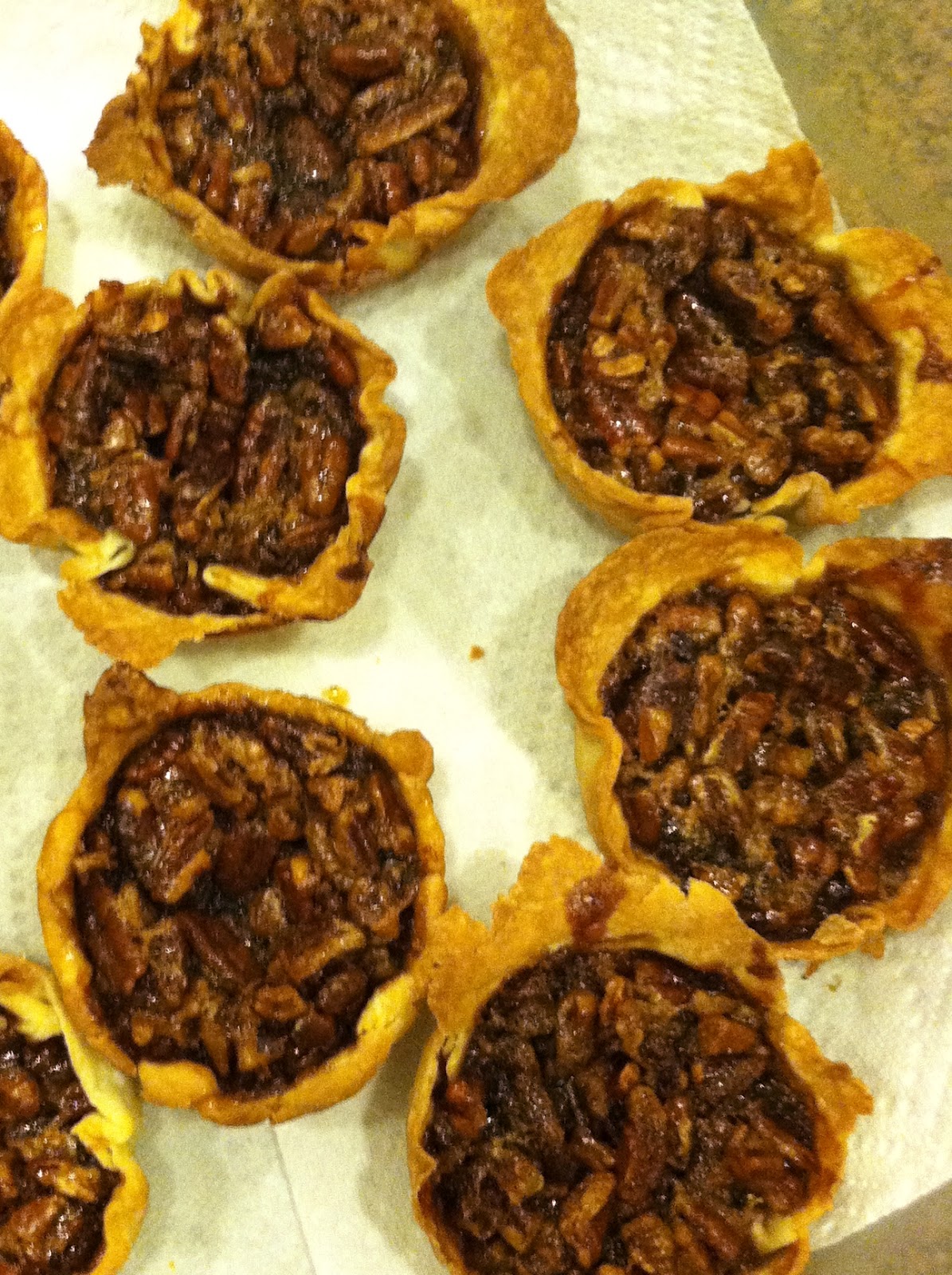
Recipe Time Out: My Old Kentucky Mini Pecan Pies


I derived this recipe from two sources: Betty Crocker's New Cookbook (Macmillan, 1996) for the filling,and www.thekitchn.com for the pastry shells. The result is a chocolaty, bourbony delight in a palm-sized portion. Just the right size to keep that pesky conscience quiet!


[Editor’s Note: Though I say that the recipe serves twelve, the filling is actually enough to make 18 pies. If you don’t want to waste the extra filling, then, double the pastry shell recipe. You’ll have dough left over, but you’ll find the sacrifice is worth it.]


*WARNING: The pastry shells need to be started more than three hours before baking…


PASTRY SHELLS


Ingredients:

5 Tbsp. butter, softened
4 oz. light cream cheese
1 cup all-purpose flour
1 Tbsp. confectioner’s sugar
1/8 tsp. salt


Instructions:

Three hours before baking…

Mix softened butter and cream cheese in a large bowl until smooth. Blend in flour, a little bit at a time, confectioner’s sugar and salt. Form dough into a disk. Wrap in plastic wrap and refrigerate for three hours. (You can also put it in the freezer for 30 minutes, then in the fridge for another 30 minutes.)

When you’re ready to bake the pies…

Preheat oven to 425°. Divide dough into 12 balls (this works out to 27 grams each). Roll flat with a rolling pin and press each into the lightly greased cups of a muffin pan. Allow dough to push up over the edges.


PIE FILLING


Ingredients:

2/3 cup sugar
1/3 cup stick butter or margarine, melted
1 cup dark corn syrup
Bourbon vats in Kentucky
½ tsp. salt
2 Tbsp. bourbon
3 large eggs
1 cup pecan halves or chopped pecans
6 oz. (1 cup) milk chocolate or semisweet chocolate chips,melted


Instructions:

Beat sugar, margarine, corn syrup, salt, bourbon and eggs in a medium bowl with a wire whisk or hand beater until well blended. Stir in pecans and melted chocolate chips.

Pour filling into pastry shells, making sure not to reach the edges. Bake for 20 minutes, or until dough is golden brown. Allow to sit for five minutes. Run a knife along the edges of cups to loosen and remove each from pan. Set on wire rack to cool.


Here’s the end result:


Mmmm…finger lickin' good!


Friday, April 13, 2012

If It Was Good Enough for Al Capone...


Welcome to the conclusion of our two-part mini-series on the impact of taxes on NFL players.  Today, we take a look at some former NFL stars that have had some—shall we say—issues with handing over their hard-earned money to the government.  Some have even tried to use the system to con money out of the government.  Two of these names you’re sure to recognize; others you may be hearing for the first time.  Either way, they all have something in common:  each found out that you can run, but you can’t hide from the tax man.
 

The Juice at his sentencing in 2008
O.J. Simpson:  The former NFL running back (and murder defendant) allegedly owes the State of California $1.44 million in taxes; a tax lien was filed in his case in September 1999.  Simpson’s state of residence is now Florida, though he currently resides in the Lovelock Correctional Center in Nevada.  In 2008 he stood trial and was found guilty for robbery charges stemming from an incident in which he took sports memorabilia at gunpoint from a man in Las Vegas hotel.


Lawrence Taylor:  The Hall of Fame linebacker, who was featured in Naptime Huddle’s “Stars and Legends” series, has had his fair share of financial troubles.  He lost a significant amount of money as a victim of a scheme involving the short sale of stock in a company he started at the end of his NFL career.  His troubles didn’t end there, however.  He pleaded guilty to filing a false tax return for 1990 and in 2000 was sentenced to three months of house arrest, five years of probation and 500 hours of community service.  Of course, you may also be aware that his legal troubles have continued, as in 2011 he pleaded guilty to sexual misconduct and patronizing an underage prostitute.  He is currently serving a sentence of six years’ probation.


Jeffrey L. Walker:  Jeffrey Walker was an offensive lineman for the San Diego Chargers and New Orleans Saints over a six-year period in the late 1980s.  In October 2011, he pleaded guilty to charges of wire fraud and tax evasion; he admitted two charges and ten others were dismissed.  His crime?  He bilked investors in four states of at least $2.2 million dollars.  He told investors they were buying shares in a resort project in China.  Instead, he spent the money on himself, buying luxury cars and recreational vehicles.  He also made false statements in his federal tax returns from 2004 to 2006.  Walker’s sentencing has been delayed to give prosecutors time to identify and notify possible victims.


"Yo, Dawg! Thanks for letting me file your tax return!"
Freddie L. Mitchell, Jr.:  The former first-round pick wide receiver had a fairly lack-luster NFL career with the Philadelphia Eagles on the field.  Off the field, he made a habit of insulting opponents and making his discontent over his limited role on the team public.  He only lasted four years in the NFL, and his post-football career hasn’t panned out too well, either.  In 2008, he bought a barbecue restaurant in his home town of Lakeland, Florida, but it closed in 2009.  Mitchell turned himself in to authorities last month under an indictment for federal tax fraud charges.  He is accused, along with two partners, of recruiting professional athletes to hire them to file their returns; they would then file phony returns in the athletes’ names claiming financial losses for businesses that didn’t exist.  Nice way to make friends, huh?


Darick Holmes:  Darick Holmes is a former running back who played for the Buffalo Bills, Green Bay Packers and Indianapolis Colts in the late 1990s.  After his retirement, he bounced around from job to job, never really finding his calling.  In August 2010, Holmes was sentenced to three years’ probation, including one year of house arrest (a lenient sentence compared to the recommended one year prison term), after pleading guilty to 15 counts of felony tax fraud.  He had teamed up with another man in Buffalo to teach people how to defraud the Earned Income Credit program, which is intended to be tax relief for the poor.  The pair got portions of the refunds their “clients” received from the government.  Darick’s brushes with crime haven’t been limited to fraud, though.  In February 2009, he was robbed and shot several times while he was delivering money for a friend’s marijuana buy.  His light sentence for the tax fraud was due in large part to the testimony the judge heard about Holmes’ commitment to mentoring at-risk youth, and guiding them away from gang membership.


So, as you get ready to file your tax returns on Monday, be sure to keep these cautionary tales in mind, lest you be tempted to find a way around the tax man…

Wednesday, April 11, 2012

Yes, RG3, There is a Tax Man


As many of you are aware, the deadline for filing your 2011 U.S. federal and state tax returns is this Monday, April 16th.  Although this can be a painful time for us Americans, it may give you comfort to remember that this annual torture is also borne by professional athletes, including players in the NFL.  Whatever your occupation or income level, April 15th (or the occasional 16th) is a date to be dreaded.


What sets professional athletes apart, however, are certain tax issues that the rest of us are unlikely to face, at least on the same scale.  Today we’ll take a look at two of these taxing matters:  whether NFL fines are deductible and city wage taxes.


Are NFL Fines Tax Deductible?


What I wouldn't give for a whole season off...
If you’ve been following the latest NFL news, you’ve probably heard more than you want to about the New Orleans Saints and their “bounty” system, which paid cash bonuses for hits that caused injury to opposing players.  The fallout from the scandal was swift, and the punishment harsh:  an indefinite suspension for defensive coordinator Gregg Williams, who is now with the St. Louis Rams; head coach Sean Payton is suspended without pay for the entire 2012 season; general manager Mickey Loomis is also suspended without pay for the first eight regular season games; and the team must pay a $500,000 fine. 


The league has not yet imposed fines on the players who were involved.  However, this is only because Commissioner Roger Goodell wants to investigate further the extent of each player’s involvement.  He wants to make sure each actor’s fine is commensurate with his level of culpability.  Since the bounties were primarily player-funded, you should not expect Goodell to go lightly on anyone.


In the meantime, maybe the players involved should contact their CPAs (the NFL Players Association has already hired lawyers for them) and ask them the question I’m sure is burning in their brains:  “Will my fines be tax deductible?”*


Your first reaction might be a resounding “No.”  These acts, and most actions resulting in NFL fines, were violent, broke the rules and were just plain wrong.  The IRS, however, doesn’t always care about where items on the balance sheet fall on the morality scale.  Instead, we have to take a look at the tax code’s requirements for business expense deductions:


  The expense must be both “ordinary and necessary.”  To be “ordinary,” it has to be common and accepted in the trade or business.  An expense is “necessary” if it is “helpful and appropriate” for your trade or business.  The IRS emphasizes in Publication 535 that the expense doesn’t have to be indispensable to your business to be eligible for deduction.


  Despite its generally amoral nature, the U.S. tax code does have a kind of moral compass.  Penalties and fines that result from any violation of law are not deductible.  This can include penalties for violent crimes, as well as for nonviolent crimes, like a parking ticket.  Instead of being based in morality, though, the reason for this is that allowing such a deduction would essentially result in the government giving back the money that it took from you for the violation of law.


Now that we have the standard for a business expense deduction, let’s apply it to the case at hand.  Was the bounty system “ordinary”?  We would like to think that this was an isolated incident, but revelations from multiple sources since the story first broke would indicate otherwise.  For one thing, it appears that Gregg Williams had such a system at each of his various stops around the league—including the Washington Redskins and Buffalo Bills.  While many players have come forward condemning Williams and the Saints’ players, others have just shrugged their shoulders.  Some, like Pittsburgh Steelers linebacker LaMarr Woodley have come out and said that incentives in player contracts are much like player-sponsored bounty systems.


Now we have to ask whether the fine is necessary, meaning “helpful and appropriate.”  Certainly the players would argue that the bounty system was “helpful and appropriate” as an incentive to play with more aggression, which better positions the team for victory (this is Woodley’s basis for his comparison).  As for the payment of the fine itself, it would probably even rise to the level of “indispensable” (again, not required), since a player has to pay his fine to be able to continue playing in the league.


OK, what about the restriction on fines and penalties?  The recent Saints’ bounty system resulted in violence fueled by greed.  Morally reprehensible.  However, though bounties are prohibited by NFL rules, they are not a violation of U.S. or state law, for now.  There’s a chance this could change, though.  United States Senator Dick Durbin is putting together a Judiciary Committee hearing about the use of bounty systems in the NFL and the other professional sports leagues.  For the most part, hearings like these are little more than a good show for politicians’ constituents.  However, you never know in this town, especially if there are many more revelations of other bounty systems in the weeks and months to come.

"But Coach Williams, what if we get caught?"
"Don't worry, Vilma.  Your fines will be tax deductible!"


So, it looks like NFL fines (and fines imposed by a player's team) are deductible as business expenses.  It is important to note, finally, that business expenses must exceed two percent of an employee’s adjusted gross income to be deductible.  With the exorbitant salaries for many players, the fines levied by the NFL might not meet this standard—though in this case, the league will probably try their hardest to make it so.


City Wage Taxes (“We just lost to the Eagles and now this?!?”)


It may be news to some of you, but not others, that there are some cities and counties that impose a tax on wages earned within their boundaries.  Most jurisdictions only impose this so-called “wage tax” on residents.  However, there are some notable exceptions, cities that also impose this tax on non-residents, at an equal or lower tax rate.


What does this mean for an NFL player?  Well, for those who are residents of these cities, it means an extra ding on every paycheck.  Remarkably, it also applies to a player’s game check when that player is in a wage tax city for an away game.  In other words, a player is taxed even though he is on the visiting team.  The amount of the tax is based on the number of days you were in the city.  As you’ll see from the list below, this tax is not going to be insignificant when you consider how much an NFL player makes for playing in just one game.


The following are NFL cities that apply a wage tax, with the tax rates of each (as of August 2011): 

  San Francisco, CA  (1.5% for both residents and non-residents, imposed on employer)

  Denver, CO  (for both, $5.25 on income over $500)

  Indianapolis, IN  (1.62% for residents; 0.405% for non-residents)

  Baltimore, MD (3.05% for residents; actually a state tax for non-residents, 1.25%)

  Detroit, MI (2.50% for residents; 0.013% for non-residents)

  Kansas City, MO  (1.0% for both)

  St. Louis, MO (1.0% for both)

  New York City, NY  (between 2.9% and 3.876% for residents only)

  Cincinnati, OH  (2.10% for both)

  Cleveland, OH, (2.00% for both)

  Philadelphia, PA  (3.928% for residents; 3.4985% for non-residents)

  Pittsburgh, PA  (3.0% + $52 per year for residents; 1.0% for non-residents)


The city offered an amnesty period back in 2010
As you can see, Philadelphia, PA boasts the highest city wage tax.  Gotta feel sorry for players in the NFC East…


Well, I hope this has made you feel a little bit better about your own tax return.  If not, and you’re thinking about filing late, or perhaps contemplating an alternative to filing altogether, tune in for our next post, when we’ll look at the fates of some NFL players who tried to buck the system.


*Another question should be whether payments a player received from the bounty system need to be reported as income.  From the articles I’ve read, the answer is yes—even if they were “under the table” and in violation of league rules, income is income and should have been reported.