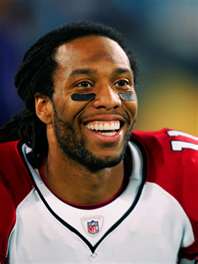
For me, though, picking the wide receiver “Legends” has been the toughest assignment of them all. There are so many stand-outs, and so little time to write, that I had to leave out some players that truly deserve to be on the list. I’m sure many of you will disagree with some of my picks, or lament the omission of certain players. Hopefully, though, today’s post will spark discussion, debate, and some memories.
All that being said, here is a list of those players whose performance at the wide receiver position stood out for me:
Jerry Rice (San Francisco 49ers, 1985-2000; Oakland Raiders, 2001-2004; Seattle Seahawks, 2004): The list of top wide receivers in NFL history must start with the most dominant pass catcher ever, Jerry Rice. Many consider him the greatest to ever play football at any position, giving him the moniker “The GOAT”, or the “Greatest of All Time.” Though his 20-year career ended with the Seattle Seahawks, Rice’s story developed with San Francisco as its backdrop. Jerry Rice attended Mississippi Valley State and was drafted in the first round of the 1985 draft by the San Francisco 49ers. It didn’t take long for the NFL to get a hint of what was to come: in his rookie season, Rice caught 49 passes for 927 yards, an impressive average of 18.9 yards per catch. His performance that season earned him NFL Offensive Rookie of the Year honors. With Hall of Fame quarterbacks Joe Montana and Steve Young throwing balls, his career only went up from there—over his career, Rice would led the league in receptions and receiving touchdowns in six different seasons, earn an incredible 13 Pro Bowl selections, be named an All-Pro 12 times. He also won three Super Bowls with the Niners; his #80 jersey has been retired by the team.

Jerry Rice owned nearly every possible record for a wide receiver, and still holds several by a large margin. For example, his record 1,549 career receptions are 447 more than runner-up Marvin Harrison; his record for receiving yards stands at 22,895, which is nearly 7,000 greater than receiver (and former Niner) Terrell Owens. Rice also holds several all-purpose records. He is still the most prolific scorer in NFL history; his 208 touchdowns surpass those of second-place holder, running back Emmitt Smith, who scored 175 in his storied career. He scored a total of 1,256 points in his career, which is the most among non-kickers. It was a surprise to no one when, in 2010, Jerry Rice was inducted into the Hall of Fame in his first year of eligibility.

Art Monk (Washington Redskins, 1980-1993; New York Jets, 1994; Philadelphia Eagles, 1995): James Arthur “Art” Monk attended Syracuse University and was drafted in the first round of the 1980 draft by the Washington Redskins. Monk was part of a three-receiver tandem known as “The Posse” that dominated passing defenses in 1989, with each amassing 1,000 yards in the season. During his tenure with the Redskins, the team won three Super Bowls and had only three losing seasons. Over the course of his career, Monk had 940 receptions for 12,721 yards and 68 touchdowns. He was selected to three Pro Bowls and was included in the NFL 1980’s All-Decade Team. In addition to several Redskins records, Monk held several NFL records at the time of his retirement. However, many of the league records, such as the record for career receptions, were broken a short while later by Jerry Rice. Art Monk was inducted into the Hall of Fame in 2008. Even his induction broke a record—for the longest standing ovation in HOF history, lasting four minutes and four seconds.

Steve Largent (Seattle Seahawks, 1976-1989): Steve Largent attended the University of Tulsa and was drafted in the fourth round of the 1976 draft by the Houston Oilers. Before the season began, however, he was traded to the Seattle Seahawks, which was in its first year of existence. While speed and agility are considered prerequisites for success at wide receiver, Largent did not quite fit the mold. What he lacked in speed, however, he made up for in consistency and sure-handedness. Over his 14-year career, Largent accumulated 819 receptions for 13,089 yards and 101 touchdowns—all records for receivers at the time of his retirement. He earned Pro Bowl selection seven times and All-Pro honors eight times. His consistency and work ethic were reflected in another record, for 177 consecutive regular-season games with a reception. Largent’s #80 jersey was the first to be retired by the Seattle Seahawks; the retirement was temporarily lifted when he gave Jerry Rice permission to wear the number when the latter joined the Seahawks at the end of his career. When Largent was inducted into the Hall of Fame in 1995, he was the first Seattle Seahawk to receive that honor.

Don Hutson (Green Bay Packers, 1935-1945): Jerry Rice and Don Hutson make perfect bookends to our discussion of all-time greatest wide receivers. While Rice took the art of catching to new heights, Hutson is considered the first modern receiver and inventor of passing routes that are still used today. In fact, some experts argue that Hutson may have equaled, or even surpassed, Jerry Rice if they had played in the same era. During Hutson’s time, the league still relied heavily on running* and rules regarding interference favored defenses. Moreover, at the time Hutson played, there were only ten or twelve games in a season and only one championship game; there were no playoffs. Finally, like many other players in the early days of football, Hutson play all sixty minutes, on both sides of the ball. He actually excelled in every facet of the game, including kicking. Hutson had thirty interceptions in his career, and in one quarter in 1945, Hutson scored an incredible 29 points—catching four touchdown passes and kicking five extra points.

After eleven years in the league, Don Hutson caught 488 receptions for 7,991 yards and 99 touchdowns. He was named an “All-NFL” nine times and held 18 records at retirement. Several of those records still stand today:
- most consecutive seasons leading the league in scoring (5—also the record for most seasons leading in that category);
- most seasons leading the league in touchdowns (8);
- most consecutive
seasons leading the league in touchdowns (4); - most seasons leading the league in receiving (8); most seasons leading the league in yards gained (7);
- most consecutive seasons leading the league in yards gained (4);
- most seasons leading the league in receiving touchdowns (9); and
- most consecutive seasons leading the league in receiving touchdowns (twice—5 between 1940 and 1944 and 4 between 1935-1938).
*In fact, it was a timing quirk that put Hutson on the path to receiving legend. After college Hutson signed two contracts: one with the Packers, who were very pass-happy, and another with the Brooklyn (NFL) Dodgers, a team that relied heavily on the running game and rarely passed. NFL President Joe Carr decided that Hutson would be bound by the contract with the earlier postmark. The Packers’ contract was postmarked only 17 minutes earlier than the Dodgers’ contract. Wouldn’t it have just been easier if he had emailed them?